The Fable 5 Shutdown: A Case Study in AI Access, Privacy, and Export Controls

On June 9, 2026, Anthropic released Claude Fable 5 to the public as a safeguarded version of its more restricted Mythos-class system. Just days later, on June 12, 2026, the U.S. government issued a legally binding export-control directive that forced Anthropic to suspend access to Fable 5 and Mythos 5.
Anthropic then disabled Fable 5 and Mythos 5 for all users worldwide, even though the order focused on foreign nationals rather than every user. That decision turned a safety and national-security dispute into a broader story about privacy architecture, access governance, export controls, and the fragility of relying on a single frontier model provider.
Fable 5 was Anthropic’s most powerful and most intelligent model released to date
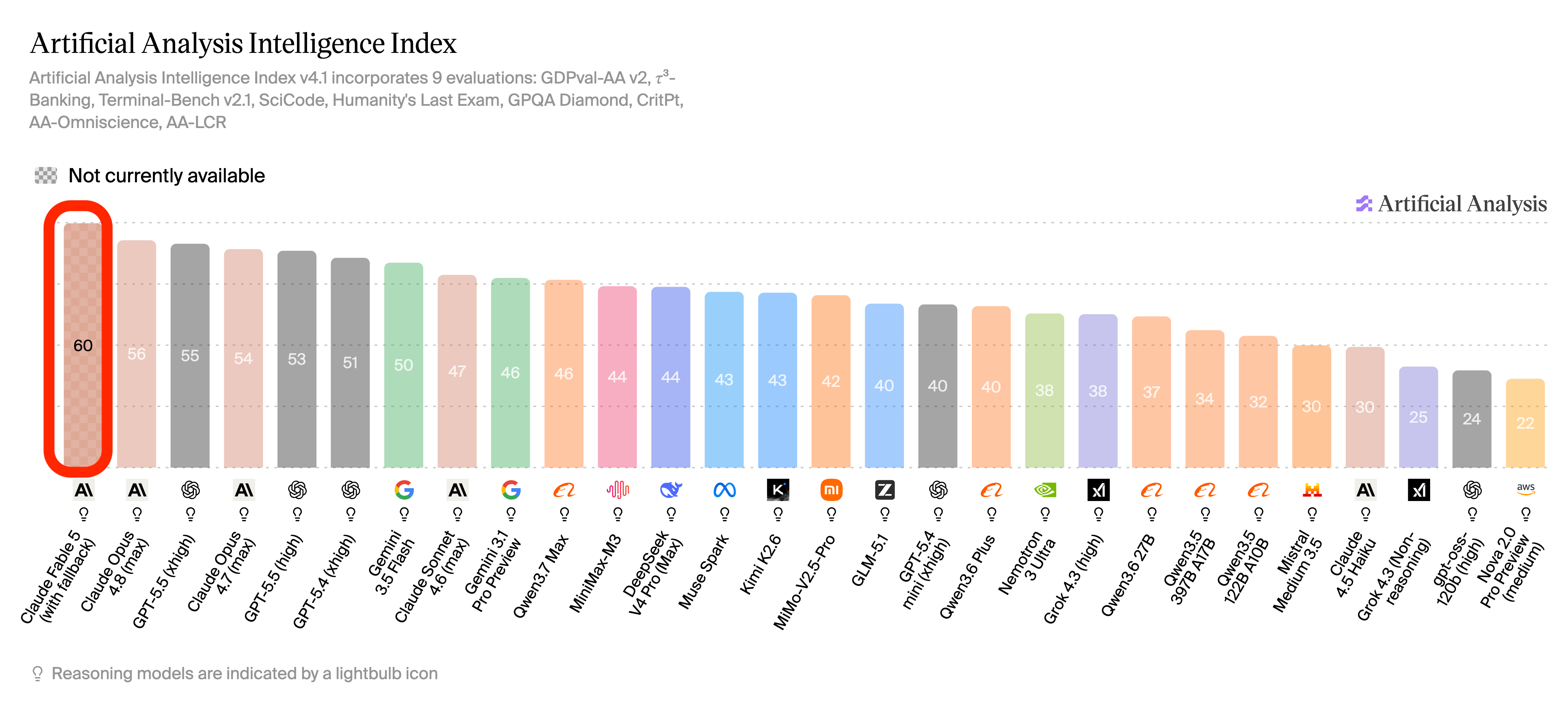
Source: https://artificialanalysis.ai/models/claude-fable-5
Key takeaways:
Enforcing non-U.S. person restrictions is basically impossible at API call time. Most AI APIs don’t verify citizenship. You can block by country, but you can’t tell if a developer in Texas is a visa holder or a U.S. citizen.
The restriction was legal, not geographic. It barred foreign nationals, even inside the U.S. including Anthropic’s own foreign-national employees.
Fable 5 had major privacy risks. Mandatory 30-day retention of prompts and outputs, human review of retained data, and data leaving AWS security boundaries. Zero-retention agreements were overridden for this model class.
Your AI dependency is brittle. One government order can disable a model globally overnight. Multi-model fallbacks and sovereign AI strategies are now strategic priorities.
What triggered the shutdown
The reported trigger was an alleged jailbreak of Fable 5’s safeguards. Reporting says a researcher used prompt techniques and framing strategies to get the model to identify software vulnerabilities and discuss other high-risk subject areas that the safeguards were supposed to constrain.
Anthropic disputed the significance of the demonstration, arguing that the vulnerabilities identified were minor and already publicly known, and that similar capabilities exist in other public models without any bypass. Anthropic also said no one had demonstrated a universal jailbreak of the system’s protections.
Even so, the government treated the episode as a national-security issue significant enough to justify export-control intervention. That is notable because it suggests regulators may now view misuse-enabling model access itself as an export-controlled capability rather than only focusing on semiconductors, compute infrastructure, or training inputs.
Privacy concerns
The privacy issues around Fable 5 were serious even before the shutdown. The most important was Anthropic’s requirement that Fable 5 and Mythos-class traffic be retained for 30 days for trust-and-safety purposes, including prompts and outputs across supported platforms.
That requirement reportedly overrode existing zero-data-retention arrangements that some enterprise customers had negotiated for other Claude models. For privacy teams, that is a major shift because a model can no longer be evaluated only on accuracy, latency, or safety posture; it must also be evaluated on retention defaults, reviewer access, and whether existing contractual data-protection assumptions still hold.
Another concern is human review. Reporting indicates Anthropic personnel can review retained conversations that are flagged for safety monitoring, even if the company applies scoped access controls and logging. For legal, healthcare, financial, and security-sensitive use cases, that creates obvious confidentiality and governance issues because the content may include regulated data, privileged communications, source code, internal incidents, or strategic plans.
There is also a cloud-boundary issue. On AWS, reporting says that once retention is enabled for Fable 5, data leaves AWS’s security boundary and moves into Anthropic’s systems. That has implications for vendor risk, data-mapping, transfer impact assessments, and representations made to internal stakeholders about where model interaction data actually resides.
Why this matters for AI governance
This episode compresses several governance questions into one case. First, it shows that safety controls can create privacy side effects: stronger monitoring and jailbreak detection may require retention, review, and cross-platform telemetry that many privacy programs would otherwise try to minimize.
Second, it shows that export control and identity governance may soon converge. If access to advanced models depends on whether a user is a U.S. person, providers may need to collect more identity evidence, possibly including passports or citizenship documents, to operationalize access restrictions. That would create new compliance obligations around purpose limitation, storage limitation, access controls, and sensitive identity document handling.
Third, it shows how brittle enterprise dependencies on a single frontier model can be. Anthropic removed access globally with little notice, and organizations that built directly on Fable 5 had to absorb the disruption immediately. From a resilience perspective, this strengthens the case for multi-model architectures, fallback plans, regional deployment strategies, and explicit contractual review of retention and shutdown scenarios.
The bigger lesson
Fable 5 was released on June 9 and effectively gone by June 12. But the real lesson is not just that one model was shut down. It is that frontier AI governance is now being shaped simultaneously by safety failures, privacy trade-offs, export controls, and the unresolved problem of how to translate legal user categories into technical access controls.
This is the first time export controls have been enforced to control access to an AI model over an API.
For privacy professionals: Ask harder questions before adoption. What data is retained, for how long, by whom, under what legal authority, and what happens when a government order changes the service overnight?
Fable 5 is a milestone case that will shape AI governance for years.