Operationalizing Privacy by Design (PbD): A Technologist’s Perspective

There are many ways one can operationalize Privacy by Design. Boiling the ocean should definitely not be one of them. Today we have a guest post from a dear friend Pruthvi Gurram an Engineering Manager leading the Privacy Technology at American Airlines. Pruthvi has shared his views via a thorough and comprehensive write up on this topic.
In today’s data-driven economy, privacy is no longer a compliance checkbox, it’s a core product feature and a competitive differentiator. As a Privacy Practitioner, I’ve seen firsthand how embedding privacy into technology design transforms not only risk posture but also customer trust. The question is: how do we move from theory to practice? How do we operationalize Privacy by Design (PbD) in a way that scales across complex systems and aligns with adjacent technology, cyber and AI risk processes?
Privacy as a Core, Pre-emptive Product Feature
Privacy cannot be an afterthought bolted onto a finished product. It must be treated as a pre-emptive design principle, much like security or performance. This means privacy considerations should influence architecture decisions, data flows, and user experience from the earliest stages of development. When privacy becomes a core feature, it drives innovation faster and makes outcomes safer.
Shifting Privacy Left
Borrowing from DevSecOps, the concept of “shifting left” applies equally to privacy. Instead of waiting for legal teams to review post-build, privacy requirements should be codified into technical specifications at the design phase. This approach reduces costly rework, accelerates compliance, and ensures privacy is embedded in the DNA of the product.
Practical Steps:
Integrate Privacy Reviews into business idea, finance and procurement, infrastructure provisioning and agile development processes so that every feature is evaluated for data minimization and lawful processing.
Automate privacy checks in CI/CD pipelines using tools that scan for personal data exposure or improper retention.
Leverage threat modeling frameworks to identify privacy risks alongside security vulnerabilities.
Translating Legal Requirements into Technical Controls
Legal obligations like data subject rights (DSRs) and transparency requirements often feel abstract to engineers. The key is to translate these into measurable, testable technical specifications:
Right to Access → API endpoints for data export in machine-readable formats.
Right to Erasure → Automated deletion workflows tied to identity verification.
Transparency → Dynamic privacy notices integrated into UI, updated via configuration rather than hard-coded text.
By defining these as acceptance criteria in user stories and providing detailed technical specifications, privacy becomes part of the engineering vocabulary.
Leveraging Adjacent Cyber Risk Processes
Privacy and security share common ground and need to co-exist to ensure comprehensive protection. By aligning PbD with existing cyber risk frameworks (e.g., NIST CSF, ISO 27001), organizations can:
Map privacy risks to existing risk registers for unified governance.
Use security controls as privacy enablers, such as encryption for data minimization or access controls for purpose limitation.
Embed privacy metrics into enterprise dashboards alongside security KPIs for holistic oversight.
AI and Privacy by Design: The New Frontier
Artificial Intelligence introduces unique privacy challenges like data volume, inference risks, and opaque decision-making. Operationalizing PbD in AI systems requires rethinking traditional controls:
Key Considerations for AI Systems
Data Minimization in Training: Use synthetic data or federated learning to reduce exposure of personal data.
Explainability and Transparency: Implement model cards and data lineage documentation as part of user story and feature acceptance criteria.
Bias and Fairness Audits: Extend PbD principles to include fairness as a privacy-adjacent risk, ensuring ethical data use.
Automated Rights Fulfillment: Build APIs that allow individuals to exercise rights (e.g., opt-out of profiling) without manual intervention.
Operational Tactics
Embed privacy risk scoring into AI model governance workflows.
Use privacy-preserving techniques like differential privacy and homomorphic encryption for sensitive datasets.
Align AI governance with privacy frameworks (e.g., OECD AI Principles, EU AI Act) to future-proof compliance.
Practical PbD Operationalization Checklist
For All Systems
Conduct Privacy Impact Assessments (PIAs), Technical Privacy Reviews, at the design stage.
Define data minimization requirements in architecture policies and standards.
Include privacy acceptance criteria in user stories.
Automate DSR workflows (access, erasure, portability).
Implement dynamic privacy notices in UI.
Integrate privacy scanning tools into CI/CD pipelines.
Align privacy controls with security frameworks for unified governance.
For AI Systems
Use synthetic or anonymized datasets for model training.
Document data lineage and model explainability artifacts.
Perform bias and fairness audits regularly.
Apply privacy-preserving techniques (differential privacy, federated learning) for high-risk data processing activities.
Build APIs for automated rights fulfillment (opt-out of profiling).
Include privacy risk scoring in AI governance dashboards.
The Business Case for Operationalizing PbD
Operationalizing Privacy by Design is not just about compliance, it’s about resilience and trust. Organizations that build privacy into their products reduce regulatory exposure, enhance customer loyalty, and differentiate themselves in a crowded market. In an era where data ethics is a brand value, privacy-first design is a strategic advantage.
Key Takeaways for Leaders
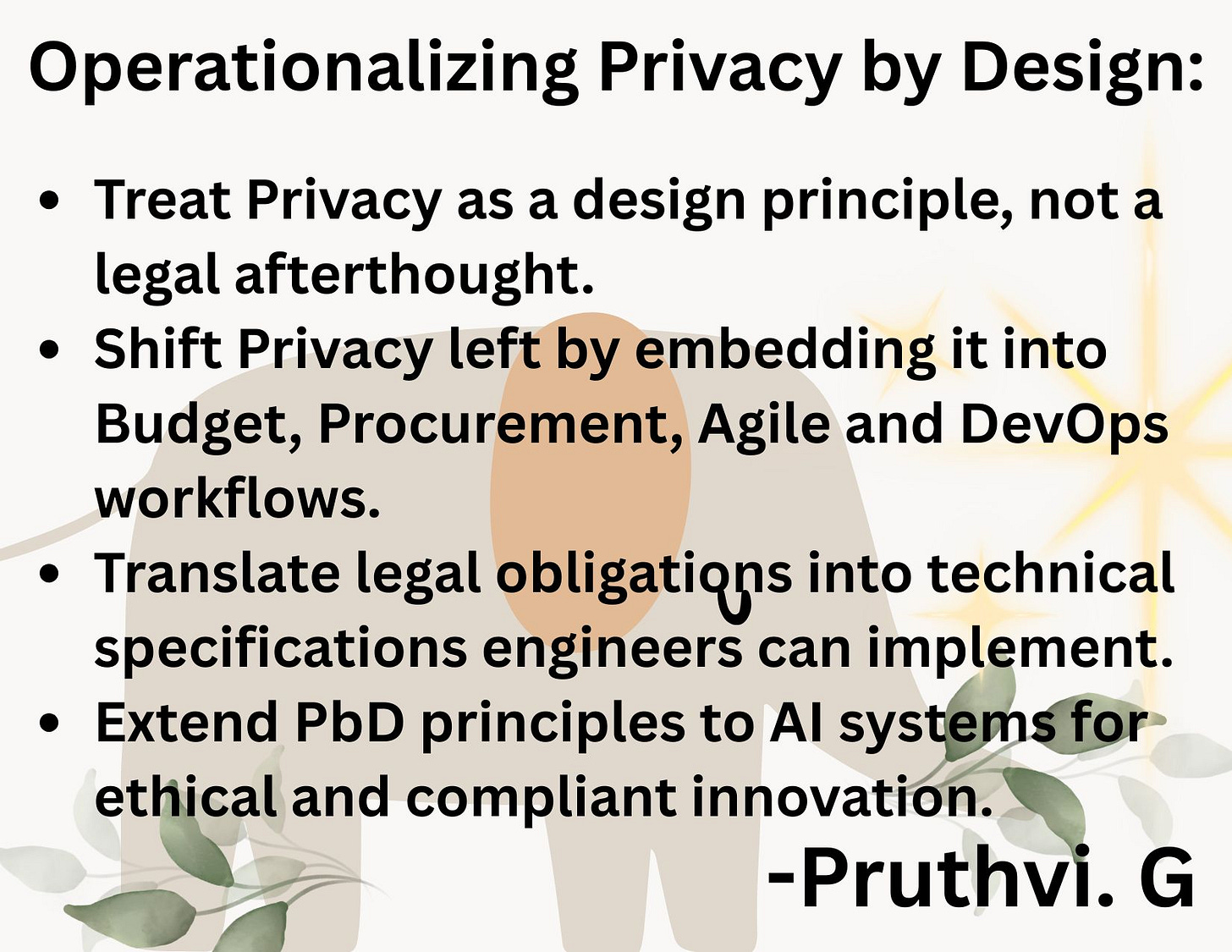
Treat privacy as a design principle, not a legal afterthought.
Shift privacy left by embedding it into Budget, Procurement, Agile and DevOps workflows.
Translate legal obligations into technical specifications engineers can implement.
Align privacy with cyber risk processes for efficiency and scalability.
Extend PbD principles to AI systems for ethical and compliant innovation.
Hey Swati! I found you through the She Writes AI community! Welcome to the community and looking forward to seeing more of your work! 🩷🦩